Project Background
For Project 3 our group worked on "Bridging the Distance", a concept for helping Hong Kong seniors feel closer to family members who live overseas. Hong Kong is aging quickly. By 2024, over 22.8% of the population are aged 65 or above, and many have children living in the UK, Canada or Australia. We talked to older adults who are mentally sharp but have health and mobility problems. Many of them said video calls feel like watching television and that they still feel lonely even when they use WhatsApp or WeChat.
Our target users are independent retirees aged 65 to 80 who want to stay connected with distant family, but find current tools tiring and impersonal. Several interviewees rated their loneliness at seven or eight out of ten on quiet days. This became the emotional starting point of our project.
Empathize Phase
My main work in this project was in the early research stage. We conducted three interviews with Hong Kong seniors: Keith (72, retired engineer in Clear Water Bay), Mrs. Chan (68, retired teacher in Yau Ma Tei), and Mr. Lam (75, former shop owner in Fanling). I helped prepare the interview questions, joined the in-person interview with Keith at HKUST canteen, and took notes on what people said about their daily lives and emotions.
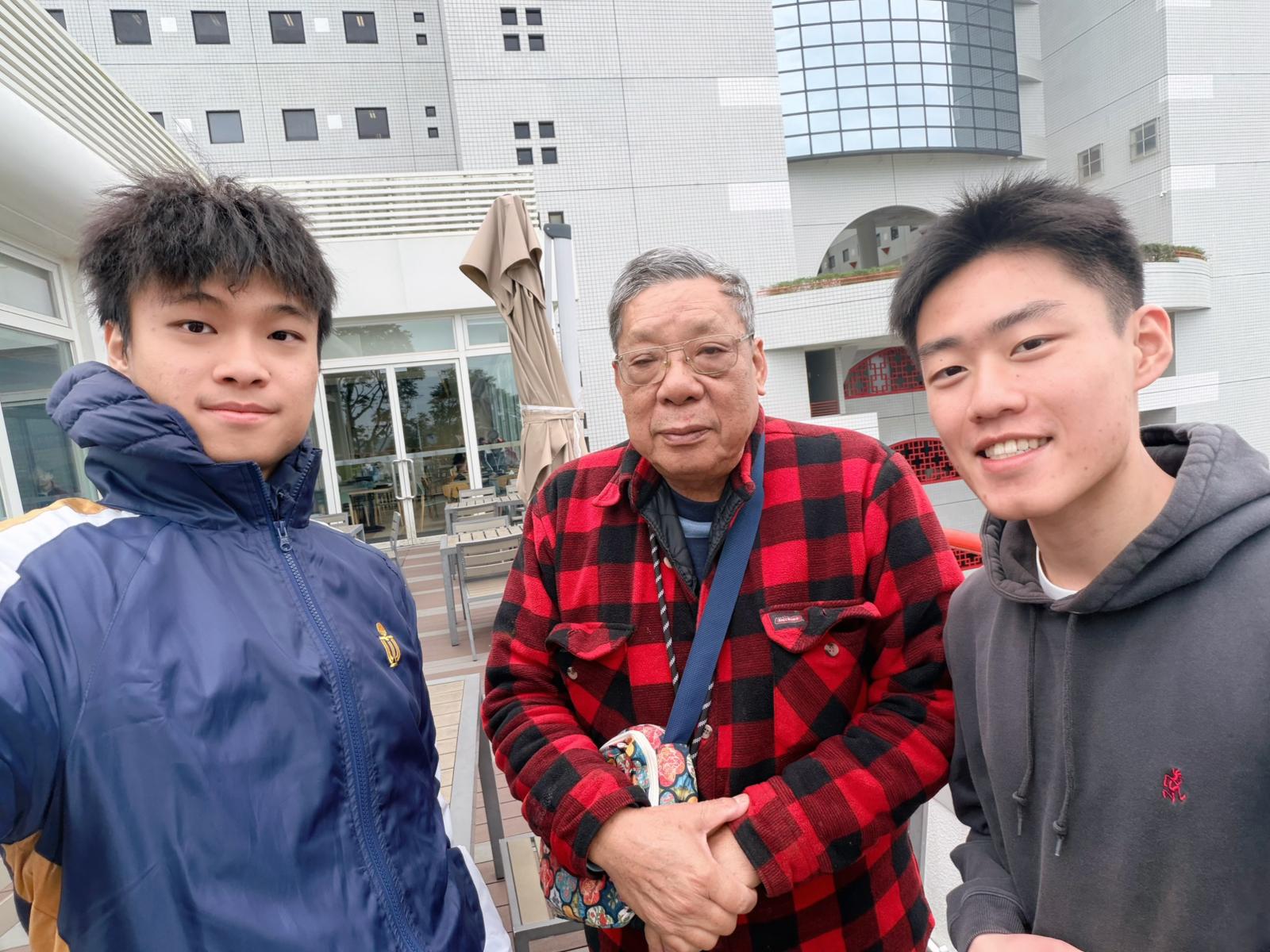
Interview with Keith at HKUST canteen, Nov 20, 2025
From these conversations, I learned that loneliness is not just about how often someone calls. It is also about whether the person feels like an active part of family life or just a passive audience watching from outside.
Interpretation
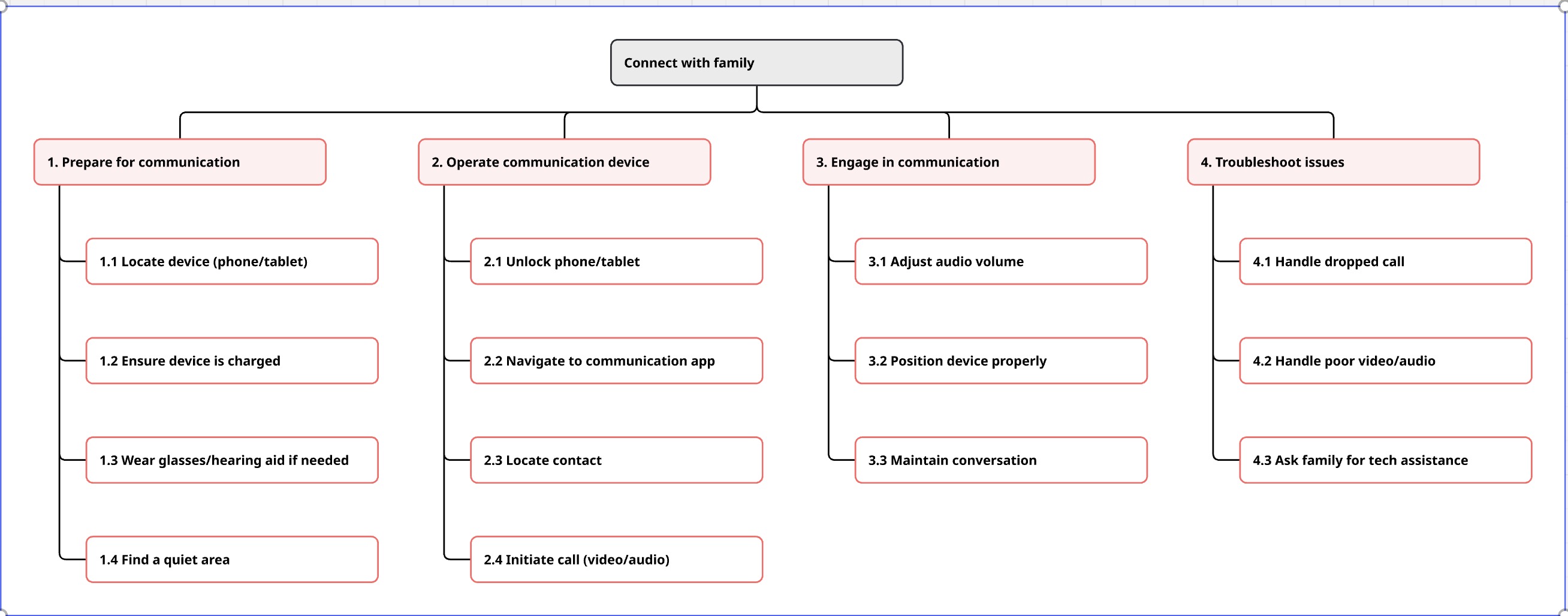
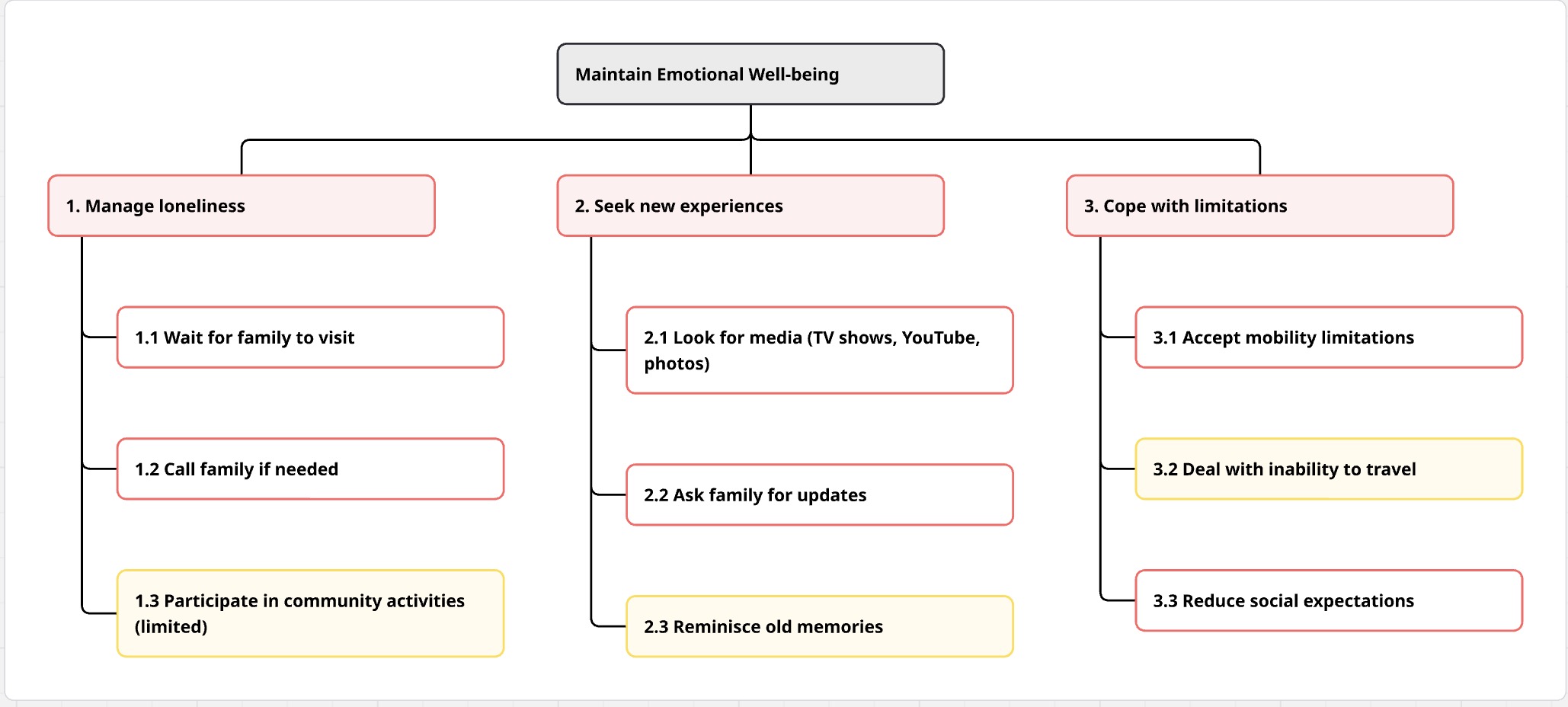
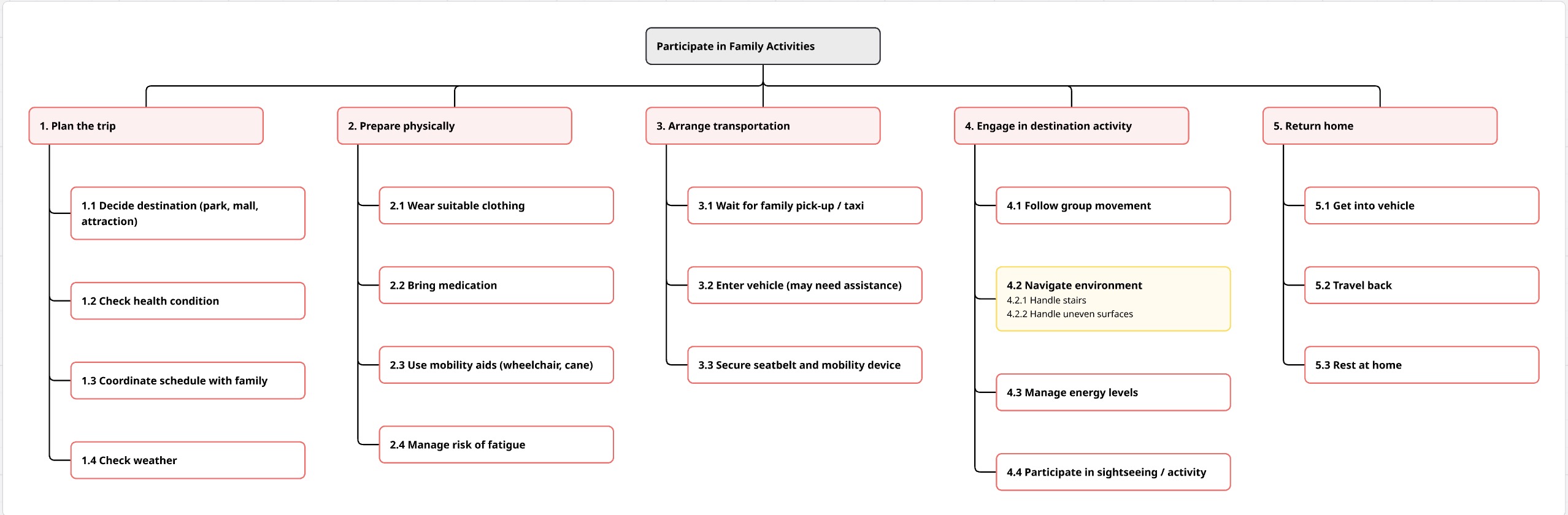
After the interviews, we turned the raw quotes into interpretation boards, clustering themes like feeling like a spectator, limitations on physical travel, technology fatigue, and the dream of joining family trips virtually. Here are the three interpretation boards our group created:
User Persona
Based on our interview findings, we created a user persona to represent a typical senior in our target group. We worked together on the persona description, including background, goals and frustrations, and refined it as a team. We tried to keep it honest and based on real quotes, not just assumptions.
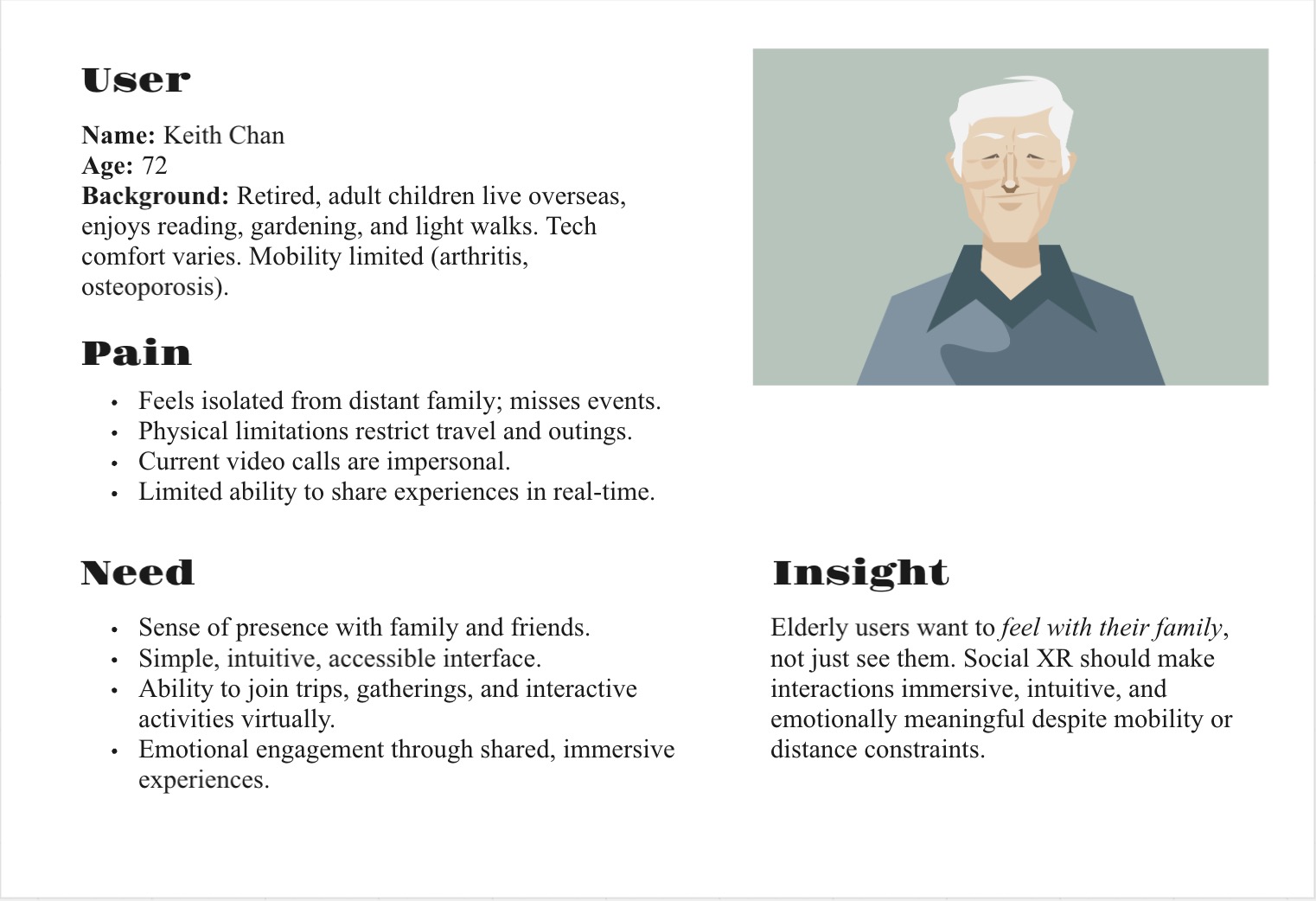
User Persona representing our target users
Ideation and Concept
During ideation we explored many directions using a mind map. We came up with three main concepts: AR Super Glasses that seniors can wear at home, a VR metaverse where family meets as avatars, and an AR "family avatar" bridge that projects family members into the room.
View Mind Map (PDF)I joined discussions about possible solutions and supported the idea of AR Super Glasses, because it seemed easier for seniors to accept than a complex virtual world. I argued that VR metaverse might be too overwhelming for older adults with vertigo or motion sickness. The Super Glasses felt more realistic as a daily object, closer to habits like wearing glasses or watching TV, and easier to imagine with simple Cantonese voice commands.
Selected Concept: AR Super Glasses
I suggested that the glasses should feel like simply sitting together with family and that backgrounds could match real trips, such as cherry blossoms in Japan. The key was making the operation almost effortless: put on the glasses, say a voice command, and you are already there with your family.
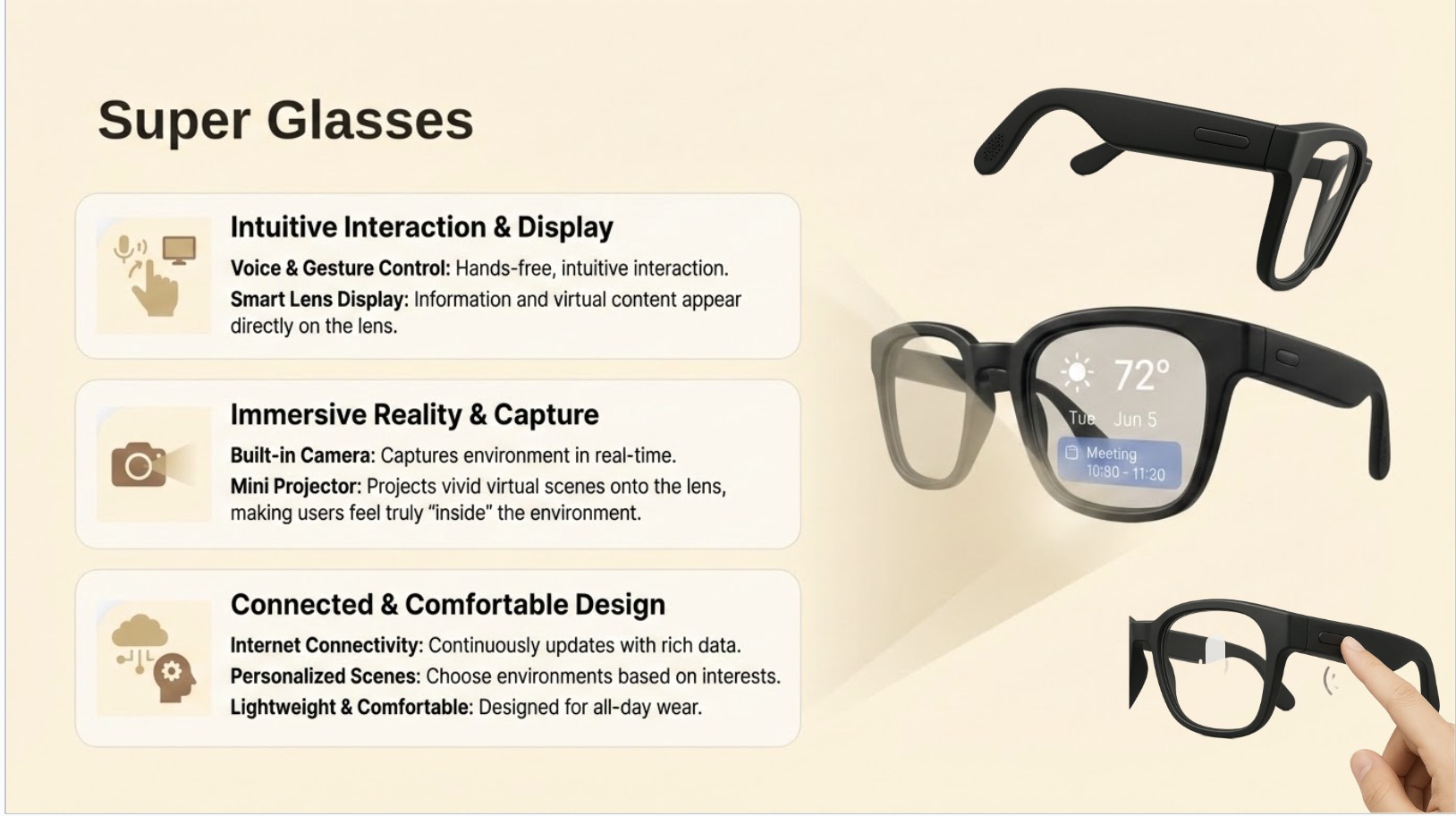
AR Super Glasses concept design
Prototype and Testing
Other teammates led the detailed prototype work, but I joined discussions about what scenes must appear in the demo video. We created a video prototype to show the user experience.
Watch Prototype VideoFor usability testing, we also made a storyboard to guide the testing process.
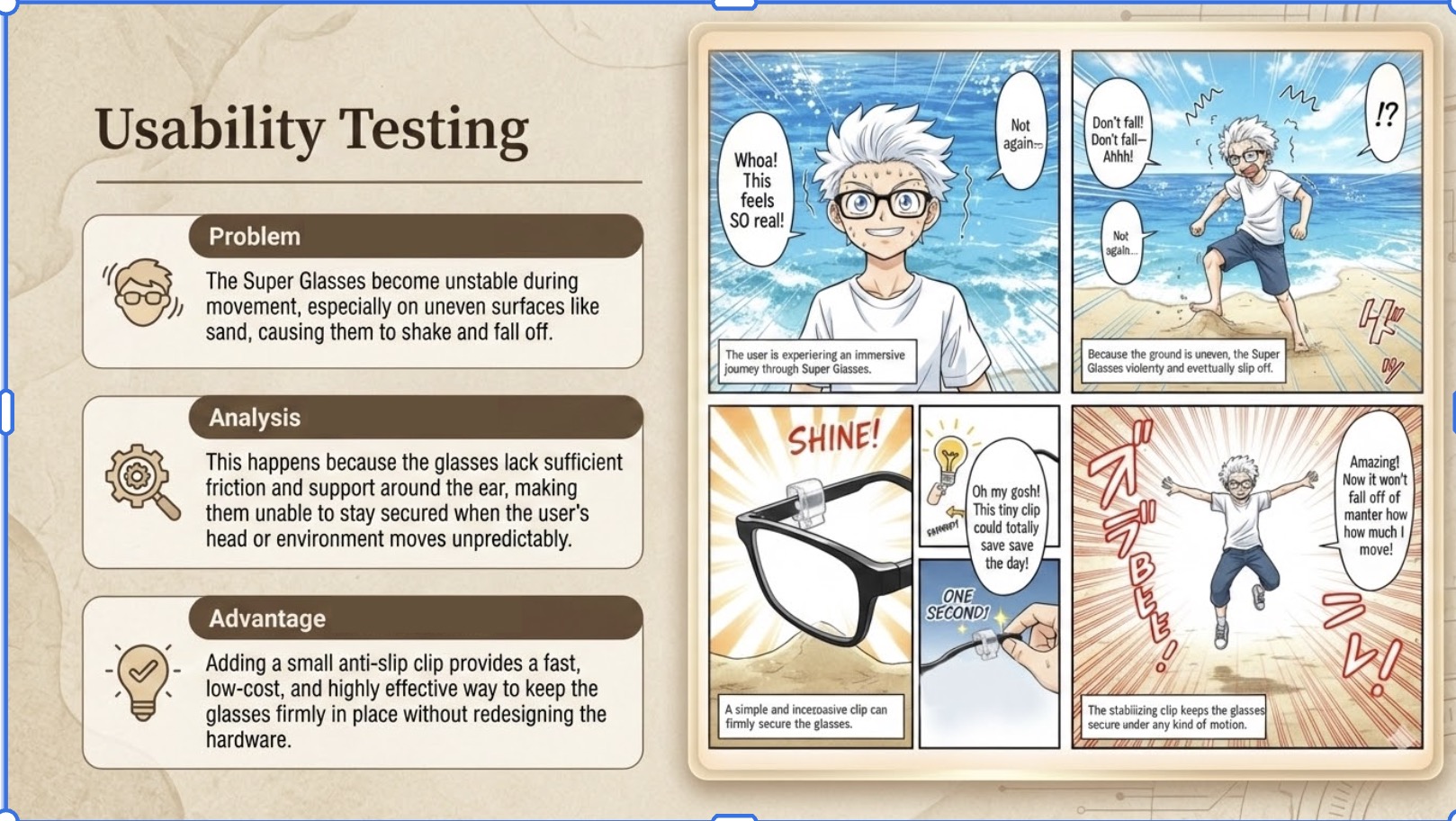
Usability testing session
Presentation
I also took responsibility for structuring the presentation slides, choosing which findings and images to show, and shaping the story we told in class. I worked on turning long interview notes into shorter, emotionally focused sentences. The goal was to keep each slide centred around one main idea, leaving space for us to explain details verbally rather than cramming everything onto the screen.
AI Usage and Reflection
I did use AI tools in a limited way during this project. They helped me shorten interview transcripts into notes, polish some English sentences, and organise this diary. I always checked everything against our real data and my own memories. The ideas, design choices and reflections come from our group work and my own thinking, not from the AI.
For example, when summarising interview quotes I would compare the AI output with the original transcript to make sure no important emotions or meanings were lost. When writing slide titles I sometimes asked AI for alternative wording ideas, but I selected and modified them myself based on what felt right for our users and our story.
Personal Reflection
This project taught me to listen more carefully to older adults and to see loneliness not only as a lack of contact but as a feeling of being left out. Before this project, I thought staying connected was mostly about calling more often or sending more messages. But after talking to Keith, Mrs. Chan and Mr. Lam, I realised that frequency is not the problem. The real issue is whether they feel like they are still part of family life, or whether they have become an audience watching from outside.
Working on the empathize phase was meaningful to me because it forced me to slow down and really pay attention to what people said, not just the words but also the emotions behind them. When Keith told us that video calls feel like watching TV, I could sense how frustrating that must be for someone who used to have long conversations with colleagues and friends every day. That kind of insight does not come from reading articles or looking at statistics. It comes from sitting with someone and letting them share their story.
I also learned that my strength in a team can be in empathy and storytelling, not only in technical work. I used to think that the most important contributions in a project are coding or building prototypes. But through this experience, I saw how much value there is in understanding users deeply and then communicating that understanding clearly to others. The presentation would not have worked if we just listed features. It worked because we told a story that made people care.
The biggest lesson for me is that designing for older adults is not only about making buttons bigger or interfaces simpler. It is also about protecting their dignity and helping them feel present again in their own families. I hope I can carry this mindset into future projects, whether they involve seniors or other user groups. Everyone deserves to feel included, not just served.